
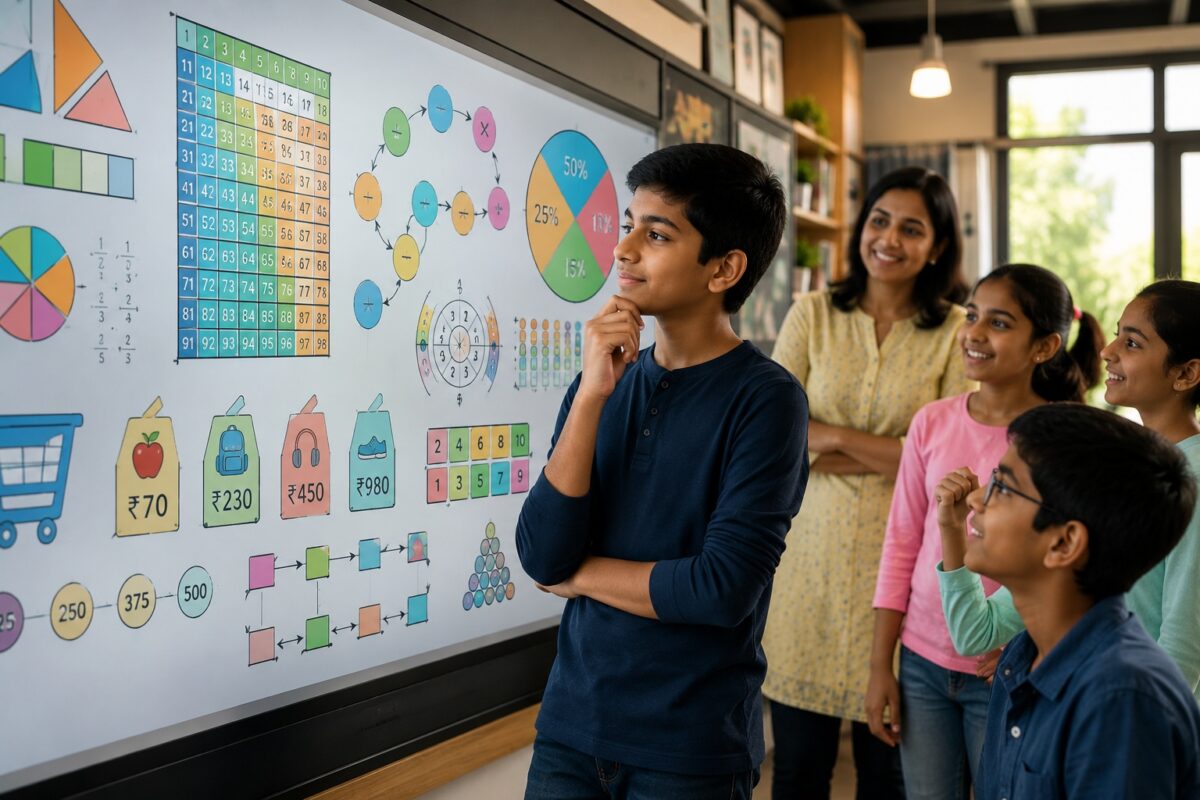
Imagine being able to calculate a discount while shopping, estimate the total cost of several items, check whether an answer makes sense, or solve a simple percentage problem without immediately reaching for a calculator.
These abilities come from strong mental maths skills.
Mental maths is the ability to perform mathematical calculations in your mind using number relationships, patterns, and efficient strategies. For school students, developing this skill is about much more than calculating quickly. It strengthens number sense, improves concentration, supports problem-solving, and builds confidence when approaching mathematics.
Students who depend heavily on calculators or written calculations may sometimes struggle with basic numerical operations during examinations. In contrast, students with good mental arithmetic skills can often recognize patterns, estimate answers, and detect calculation errors more easily.
At CH Math Tuition Point, we encourage students to develop mental maths alongside their regular curriculum. The goal is not to replace written methods for complex problems but to give students another powerful tool that makes everyday mathematics easier and more intuitive.
In this article, we’ll explore how mental maths improves speed and confidence, practical techniques students can use, and simple ways to incorporate mental calculation into daily learning.
What Is Mental Maths?
Mental maths refers to performing calculations without relying entirely on a calculator, mobile phone, or lengthy written working.
For example, consider:
25 × 16
Instead of performing traditional long multiplication, a student might think:
25 × 4 = 100
Therefore:
25 × 16 = 25 × 4 × 4 = 400
This approach uses number relationships to simplify the calculation.
Mental maths is not about memorizing hundreds of tricks. It is about understanding numbers well enough to manipulate them efficiently.
Why Are Mental Maths Skills Important?
Mental calculation develops several abilities simultaneously.
Students with strong mental maths skills often become better at:
- Basic arithmetic
- Estimation
- Number recognition
- Pattern identification
- Calculation speed
- Mathematical reasoning
- Checking answers
- Problem-solving
These benefits support students across multiple areas of mathematics, including algebra, percentages, ratios, statistics, and geometry.
1. Mental Maths Builds Strong Number Sense
Number sense is the ability to understand how numbers relate to one another.
A student with good number sense knows instinctively that:
- 50 is half of 100.
- 25 is one-quarter of 100.
- 0.5 is equivalent to 50%.
- 3/4 is equivalent to 75%.
These connections make mathematics easier.
Instead of treating every calculation as a completely new problem, students begin to recognize familiar relationships.
For example:
75% of 200
A student who understands percentages can quickly recognize:
50% of 200 = 100
25% of 200 = 50
Therefore:
75% of 200 = 150
This type of thinking is faster and strengthens conceptual understanding.
2. It Improves Calculation Speed
Speed becomes particularly important during timed examinations.
Students who spend too much time on basic calculations may have less time available for complex questions.
Mental maths helps students complete simple calculations quickly so they can focus their attention on the more challenging parts of a problem.
For example, knowing multiplication tables instantly reduces the time needed for:
- Fractions
- Factorization
- Ratios
- Algebra
- Division
The objective is not to rush. The goal is to become naturally efficient through regular practice.
3. Mental Maths Can Improve Accuracy
At first, it may seem that written calculations are always safer.
However, mental maths can also serve as an excellent checking tool.
Suppose a student calculates:
49 × 21 = 10,290
Even without solving the entire problem again, estimation immediately reveals something is wrong.
Since:
50 × 20 = 1,000
The correct answer should be somewhere near 1,000—not 10,000.
This ability to estimate helps students detect unreasonable answers before submitting their work.
4. It Builds Confidence in Mathematics
Students often become nervous when they see numbers that appear difficult.
Mental maths teaches them to break calculations into simpler parts.
For example:
98 + 47
Instead of adding directly, think:
98 + 2 = 100
47 − 2 = 45
Therefore:
98 + 47 = 145
Once students discover that complicated-looking calculations can be simplified, mathematics begins to feel more manageable.
Every successful calculation builds confidence.
5. Mental Calculation Strengthens Concentration
Mental maths requires students to hold information temporarily while performing calculations.
This exercises:
- Attention
- Working memory
- Focus
- Numerical reasoning
Short daily mental maths exercises can therefore become an effective way to prepare the brain for a mathematics study session.
6. It Helps Students Estimate Answers
Estimation is an important but sometimes overlooked mathematical skill.
Consider:
₹497 × 6
Before calculating exactly, a student can estimate:
₹500 × 6 = ₹3,000
Therefore, the final answer should be close to ₹3,000.
Estimation allows students to judge whether their final calculations are reasonable.
This skill is particularly useful in word problems and everyday situations.
7. Mental Maths Makes Algebra Easier
Strong arithmetic skills create a foundation for algebra.
Consider the equation:
7x = 56
A student who immediately recognizes that 7 × 8 = 56 can quickly identify:
x = 8
Similarly, multiplication tables and factor knowledge help with:
- Factorization
- Algebraic expressions
- Equations
- Fractions
- Common factors
Students who struggle with basic arithmetic often spend extra time performing calculations that distract them from understanding the algebra itself.
8. It Is Useful in Everyday Life
Mental mathematics is not limited to classrooms and examinations.
Students and adults use it while:
- Shopping
- Calculating discounts
- Dividing bills
- Managing money
- Measuring ingredients
- Planning travel time
- Comparing prices
- Estimating distances
For example, if an item costing ₹800 has a 25% discount, a student with good mental maths skills can quickly calculate:
25% of ₹800 = ₹200
Discounted price = ₹600
These practical applications show students why mathematics matters beyond school.
Technique 1: Break Numbers Apart
Consider:
37 + 48
Break 48 into 40 and 8.
37 + 40 = 77
77 + 8 = 85
Breaking numbers into manageable parts simplifies calculations.
Technique 2: Round and Adjust
Consider:
199 + 76
Round 199 to 200.
200 + 76 = 276
Now subtract 1.
Answer = 275
This method is useful when numbers are close to convenient values such as 10, 100, or 1,000.
Technique 3: Double and Halve
Consider:
25 × 24
Double 25 and halve 24:
50 × 12
Repeat:
100 × 6
Answer = 600
This technique works well for certain multiplication problems.
Technique 4: Use Known Percentages
Students should become comfortable with common percentages.
For example:
- 50% = half
- 25% = one-quarter
- 10% = divide by 10
- 5% = half of 10%
- 1% = divide by 100
Suppose you need to calculate 15% of 200.
10% = 20
5% = 10
Therefore:
15% = 30
Understanding relationships is often easier than memorizing separate procedures.
Technique 5: Learn Squares of Common Numbers
Knowing common squares can improve calculation speed.
Examples include:
- 5² = 25
- 10² = 100
- 12² = 144
- 15² = 225
- 20² = 400
This knowledge becomes especially useful in algebra and geometry.
How CH Math Tuition Point Helps Students Strengthen Mental Maths
At CH Math Tuition Point, we focus on developing both conceptual understanding and practical calculation skills.
Our approach includes:
- Number-sense activities
- Mental calculation exercises
- Multiplication practice
- Estimation techniques
- Speed-and-accuracy activities
- Regular assessments
- Personalized guidance
Students are encouraged to understand the reasoning behind calculations rather than simply memorizing shortcuts.
By strengthening fundamental numerical skills, students can approach advanced mathematics with greater confidence.
Conclusion
Mental maths is not simply about calculating faster. It teaches students to understand numbers, recognize patterns, estimate results, and approach mathematical problems with greater flexibility.
Strong mental calculation skills can support students in arithmetic, algebra, percentages, fractions, examinations, and everyday decision-making.
The key is regular, focused practice.
Students should begin with simple calculations, prioritize accuracy, understand the reasoning behind each technique, and gradually develop speed.
At CH Math Tuition Point, we help students from Classes 6–10 strengthen their mathematical foundations through concept-based learning, regular practice, and personalized guidance.
When students become comfortable working with numbers, mathematics often becomes less intimidating—and much more enjoyable.
Call to Action
Build Faster, Stronger and More Confident Maths Skills
Help your child strengthen mental calculation, number sense, and problem-solving abilities with structured mathematics coaching at CH Math Tuition Point.
Admissions Open for Classes 6–10
📍 Location: Vivekananda Nagar, Kukatpally, Hyderabad
📞 Book a Demo Class Today!