
Mathematics is often about understanding how quantities relate to one another.
A recipe may need two cups of flour for every one cup of sugar. A map may use a particular scale to represent a large distance. A class may have a certain number of boys compared with girls. A shop may offer different quantities of products at different prices.
These situations involve ratios and proportions in maths.
For students in Classes 6–10, learning ratios and proportions is not simply about memorising a method. It helps them understand relationships between quantities and apply mathematical thinking to practical situations.
Once students understand what a ratio represents and how proportional relationships work, many problems involving percentages, measurements, scale, rates, and comparisons become easier to approach.
What Is a Ratio in Mathematics?
A ratio compares two or more quantities of the same kind.
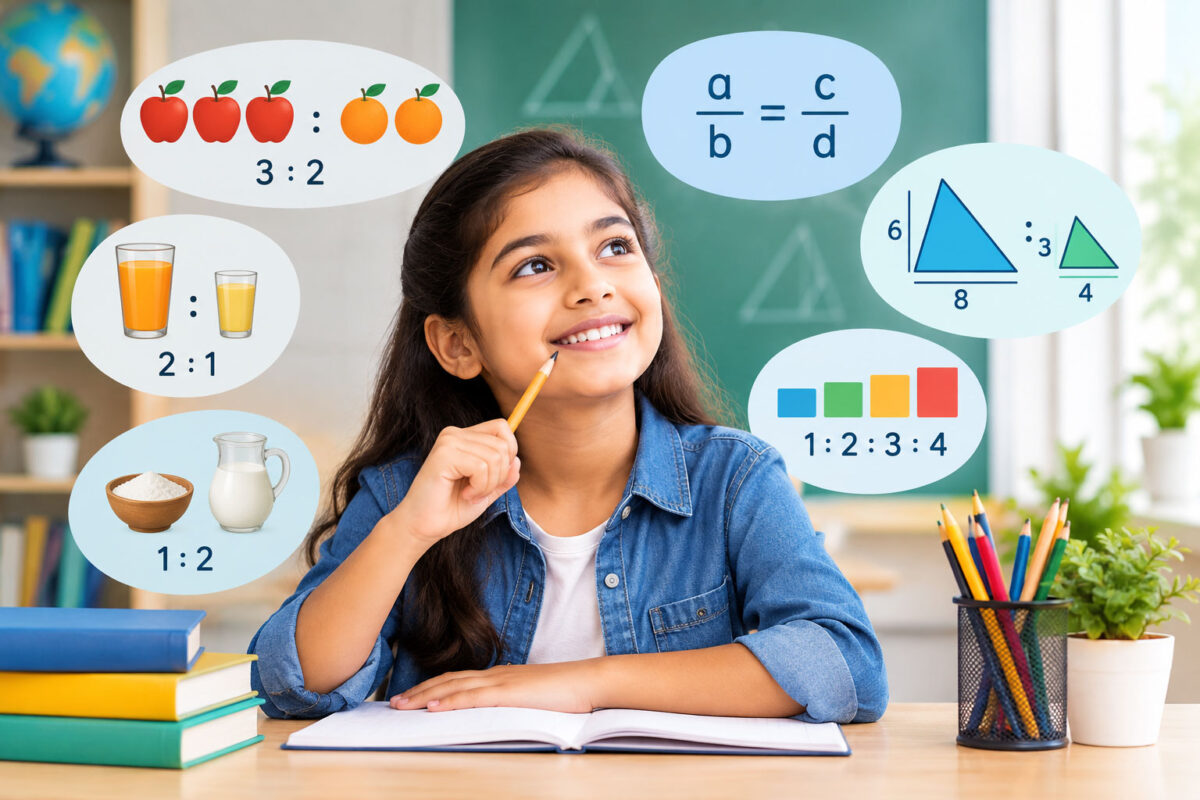
For example, if a basket contains 6 apples and 3 oranges, the ratio of apples to oranges is:
6 : 3
This can be simplified to:
2 : 1
The ratio tells us that for every 2 apples, there are 1 orange.
Students should understand that a ratio is not simply a pair of numbers. It describes a relationship between quantities.
For example:
4 : 5
means that for every 4 units of one quantity, there are 5 units of another quantity.
What Is a Proportion?
A proportion states that two ratios are equal.
For example:
2 : 3 = 4 : 6
Both ratios represent the same relationship.
Proportions are useful when one quantity changes and students need to determine the corresponding value of another quantity.
For example, if 2 notebooks cost ₹60, students can use proportional reasoning to determine the approximate cost of 6 notebooks.
The important idea is that the relationship between the quantities remains consistent.
Why Ratios and Proportions Matter in Maths
1. They Help Students Compare Quantities
Ratios give students a clear way to compare quantities.
Suppose one classroom has 20 students and another has 30 students.
Students can compare them as:
20 : 30 = 2 : 3
This makes the relationship easier to describe mathematically.
Instead of simply saying that one class has more students, students can express exactly how the quantities relate.
2. They Strengthen Mathematical Reasoning
Ratio questions require students to think about relationships rather than isolated numbers.
They need to ask:
- What quantities are being compared?
- Are the units the same?
- Can the ratio be simplified?
- Does the relationship remain constant?
- What information is missing?
This type of thinking develops mathematical reasoning that can be useful across different topics.
3. They Support Percentage Understanding
Percentages are closely connected to proportional thinking.
For example, if 25 out of 100 students participate in an activity, the proportion is:
25/100
which can be expressed as:
25%
Understanding ratios and proportions can therefore help students see why percentages represent parts of a whole.
4. They Make Real-World Problems Easier
Ratios and proportions appear in many everyday situations.
Students may encounter them when working with:
- Recipes
- Maps
- Distances
- Speeds
- Prices
- Discounts
- Mixtures
- Measurements
- Scale drawings
- Data
Connecting mathematical concepts with familiar situations can make abstract ideas easier to understand.
Common Types of Ratio Problems
Students may encounter several types of ratio questions.
Part-to-Part Ratios
A part-to-part ratio compares two separate quantities.
For example, if a box contains 8 blue pens and 4 black pens:
Blue : Black = 8 : 4 = 2 : 1
Part-to-Whole Ratios
A part-to-whole ratio compares one quantity with the total.
If there are 8 blue pens and 4 black pens, there are 12 pens altogether.
Therefore:
Blue pens : Total pens = 8 : 12 = 2 : 3
Understanding the difference between part-to-part and part-to-whole comparisons is important.
Equivalent Ratios
Equivalent ratios describe the same relationship.
For example:
2 : 5
4 : 10
6 : 15
All represent the same proportional relationship.
Students can find equivalent ratios by multiplying or dividing both parts by the same number.
How to Solve Proportion Problems Step by Step
A systematic method can make proportion questions easier.
Step 1: Identify the Two Quantities
Read the question carefully and determine what is being compared.
Step 2: Write the Known Relationship
Express the information as a ratio or proportion.
Step 3: Keep the Order Consistent
If the first ratio compares apples to oranges, the second ratio should also compare apples to oranges.
Changing the order can produce an incorrect answer.
Step 4: Find the Missing Value
Use an appropriate mathematical method to determine the unknown quantity.
Step 5: Check the Relationship
Ask whether the final answer maintains the same proportion.
This final step can help students identify calculation errors.
How Ratios Prepare Students for Advanced Maths
Ratio and proportion concepts appear in many areas of later mathematics.
Students may use proportional reasoning when learning:
- Percentages
- Probability
- Similarity
- Scale drawings
- Coordinate geometry
- Trigonometry
- Statistics
- Rates and measurement
A clear understanding of ratios can therefore provide useful preparation for more advanced topics.
How CH Math Tuition Point Helps Students Build Mathematical Understanding
Learning mathematics effectively requires students to understand concepts, practise different question formats, ask questions, and correct misunderstandings.
CH Math Tuition Point provides mathematics and science tuition for students from Classes 6–10, with online and offline learning options. The centre is located in Vivekananda Nagar, Kukatpally, Hyderabad.
A structured learning environment can help students develop:
- Concept clarity
- Mathematical reasoning
- Problem-solving skills
- Calculation accuracy
- Regular practice habits
- Doubt clarification
- Examination preparation
- Confidence in mathematics
For ratio and proportion topics, students can benefit from working through different types of questions rather than memorising a single formula or procedure.
A Simple Practice Routine for Ratios and Proportions
Students can build their skills through a short, consistent routine.
Step 1: Review the Concept
Understand what the ratio represents.
Step 2: Solve Basic Questions
Practise simple comparisons and equivalent ratios.
Step 3: Try Word Problems
Apply ratios to practical situations.
Step 4: Solve Proportion Questions
Work with missing values and changing quantities.
Step 5: Check the Relationship
Make sure the final answer maintains the original proportion.
Step 6: Review Mistakes
Record difficult question types and practise similar examples again.
This approach helps students move gradually from basic understanding to independent problem solving.
Conclusion
Ratios and proportions are important mathematical concepts because they help students understand relationships between quantities.
They appear in everyday activities such as cooking, shopping, travelling, measuring, and reading maps, while also providing foundations for more advanced mathematical topics.
Students in Classes 6–10 can strengthen their understanding by practising different types of ratio questions, using tables and diagrams, working with real-life examples, and explaining the reasoning behind their answers.
The key is to focus on the relationship between quantities rather than simply memorising a procedure.
With regular practice and clear guidance, students can develop stronger proportional reasoning and become more confident when approaching unfamiliar mathematics problems.
Call to Action
Build Stronger Maths Skills With Concept-Based Learning
Help your child develop stronger mathematical reasoning, problem-solving ability, and confidence through structured learning at CH Math Tuition Point.
Admissions Open for Classes 6–10
📍 Vivekananda Nagar, Kukatpally, Hyderabad
📞 Contact CH Math Tuition Point to enquire about mathematics tuition classes.