
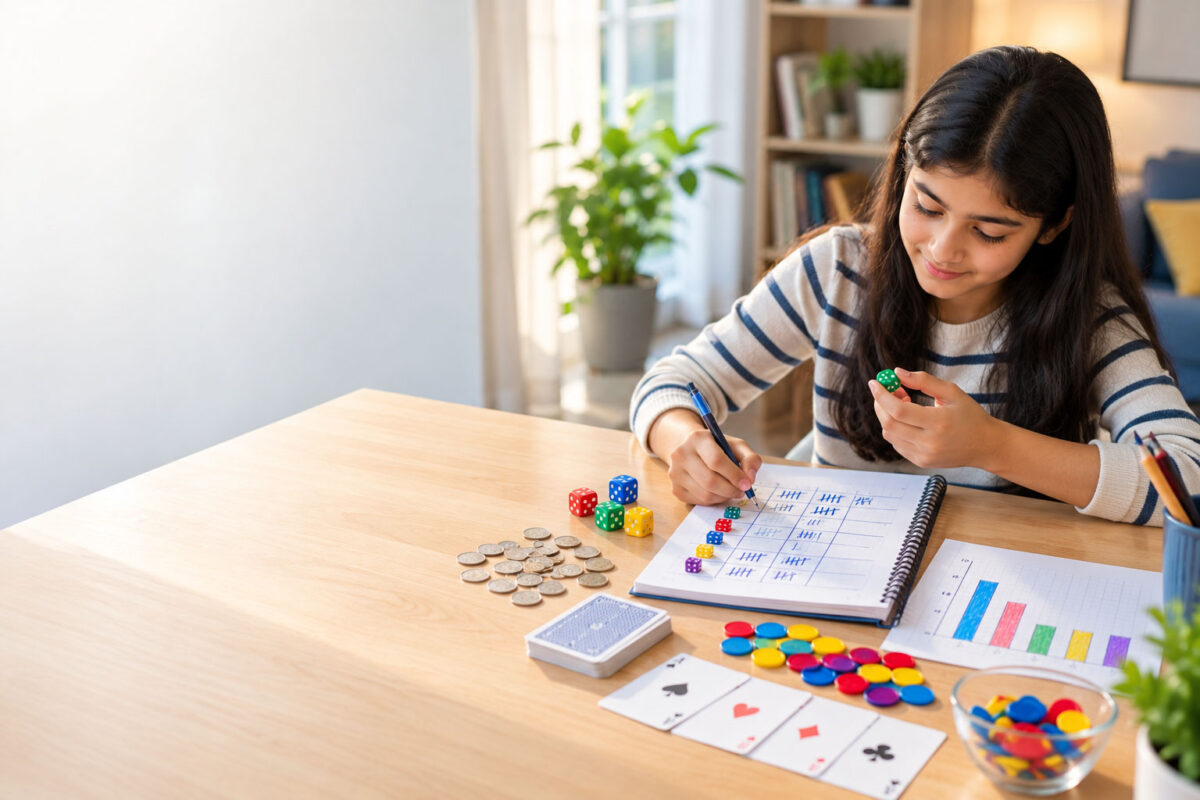
Have you ever wondered whether it will rain tomorrow, what number might appear when you roll a dice, or how likely you are to win a game? These questions involve probability.
Probability is an important part of mathematics that helps us describe uncertainty using numbers. It allows students to understand how likely an event is to happen and how different outcomes can be analysed logically.
For students in Classes 6–10, learning probability develops mathematical reasoning and introduces a useful way to interpret information. It also connects classroom concepts with games, experiments, surveys, weather forecasts, and everyday situations.
With a clear understanding of the basic rules, students can learn to solve probability questions systematically and apply the concepts to more complex problems.
What Is Probability in Maths?
Probability is the mathematical measure of how likely an event is to occur.
It is expressed as a number between 0 and 1, or as a fraction, decimal, or percentage.
- Probability of 0: The event is impossible.
- Probability of 1: The event is certain.
- Probability between 0 and 1: The event has some chance of occurring.
For example, when tossing a fair coin, the possible outcomes are heads and tails.
The probability of getting heads is:
P(Heads) = 1/2
This means there is a one-in-two chance of getting heads on a single toss of a fair coin.
Probability does not guarantee what will happen next. Instead, it describes the likelihood of an outcome.
Why Is Probability Important for Students?
1. It Develops Logical Thinking
Probability encourages students to consider possible outcomes before reaching a conclusion.
When solving a question, students must identify what can happen, determine which outcomes are favourable, and calculate the likelihood of the required event.
This process encourages careful reasoning rather than guessing.
2. It Connects Mathematics With Everyday Life
Probability is used in many real-world situations, including:
- Understanding weather forecasts
- Analysing survey results
- Studying games and sports statistics
- Evaluating possible outcomes
- Interpreting information and data
- Understanding risk and uncertainty
These applications help students recognise how mathematical ideas can be used outside examinations.
3. It Builds a Foundation for Advanced Topics
Probability is connected to statistics and data analysis. As students progress through school, they may encounter more complex questions involving experiments, distributions, expected outcomes, and statistical interpretation.
Understanding the basics early makes it easier to approach these topics later.
Basic Probability Formula Every Student Should Know
For an experiment with equally likely outcomes, the probability of an event can be calculated using:
Probability = Number of favourable outcomes ÷ Total number of possible outcomes
In mathematical notation:
[
P(E)=\frac{n(E)}{n(S)}
]
Where:
- (P(E)) represents the probability of event E.
- (n(E)) represents the number of favourable outcomes.
- (n(S)) represents the total number of possible outcomes in the sample space.
This formula applies when all outcomes are equally likely.
Example: Rolling a Dice
A fair six-sided dice has six possible outcomes:
1, 2, 3, 4, 5, 6
What is the probability of rolling a 4?
There is one favourable outcome and six possible outcomes.
Therefore:
[
P(4)=\frac{1}{6}
]
The probability of rolling a 4 is 1/6.
Understanding why the formula works is more useful than memorising it without context.
Important Probability Terms Students Should Understand
Sample Space
The sample space is the set of all possible outcomes of an experiment.
For a single coin toss:
S = {Heads, Tails}
For a fair six-sided dice:
S = {1, 2, 3, 4, 5, 6}
Identifying the sample space helps students determine the total number of possible outcomes.
Event
An event is an outcome or group of outcomes that a question asks about.
For example, when rolling a dice, getting an even number is an event.
The favourable outcomes are:
{2, 4, 6}
Favourable Outcomes
Favourable outcomes are the results that satisfy the event described in a question.
For example, when drawing one card from a standard deck of 52 cards, there are 13 hearts. Therefore, the probability of drawing a heart is 13/52, or 1/4, assuming the deck is complete and shuffled.
Equally Likely Outcomes
Outcomes are equally likely when each has the same probability of occurring.
A fair coin gives heads and tails equal chances. A fair six-sided dice gives each number an equal chance.
Students should check this condition before applying the basic probability formula.
Practical Probability Examples for Classes 6–10
Example 1: Tossing a Coin
A fair coin is tossed once. What is the probability of getting tails?
Possible outcomes: Heads, Tails.
Favourable outcomes: Tails.
[
P(\text{Tails})=\frac{1}{2}
]
Answer: 1/2 or 50%.
Example 2: Choosing a Coloured Ball
A bag contains 3 red balls, 4 blue balls, and 3 green balls. One ball is selected randomly.
What is the probability of selecting a blue ball?
Total balls:
3 + 4 + 3 = 10
Blue balls:
4
Therefore:
[
P(\text{Blue})=\frac{4}{10}=\frac{2}{5}
]
Answer: 2/5 or 40%.
Example 3: Rolling an Even Number
A fair six-sided dice is rolled once. What is the probability of getting an even number?
Even outcomes:
{2, 4, 6}
Number of favourable outcomes: 3.
Total possible outcomes: 6.
[
P(\text{Even})=\frac{3}{6}=\frac{1}{2}
]
Answer: 1/2 or 50%.
These examples demonstrate how students can identify outcomes, apply the formula, and simplify their answers.
How Students Can Improve Their Probability Skills
Regular practice helps students become more comfortable identifying possible outcomes and selecting the appropriate calculation.
Useful study habits include:
- Learn the meaning of probability terms.
- Practise listing sample spaces.
- Solve simple questions before attempting multi-step problems.
- Draw tables when several outcomes are involved.
- Explain why each outcome is favourable.
- Review incorrect answers to identify counting mistakes.
- Practise questions from the relevant school syllabus.
Students should aim to understand the reasoning behind each answer rather than memorising a formula alone.
How CH Math Tuition Point Helps Students Strengthen Maths Concepts
Developing mathematical skills requires clear explanations, guided practice, and opportunities to ask questions.
CH Math Tuition Point provides mathematics and science tuition for students from Classes 6–10, with online and offline learning options. The centre is located in Vivekananda Nagar, Kukatpally, Hyderabad.
A structured learning environment can help students strengthen their mathematical foundations, work through different question types, clarify doubts, and develop a more systematic approach to solving problems.
For probability, students can benefit from learning key definitions, understanding the formula, practising examples, and checking their reasoning at every stage.
Conclusion
Probability helps students understand uncertainty through mathematical reasoning. From tossing a coin to interpreting data, the subject provides a systematic way to calculate how likely an event is to occur.
Students in Classes 6–10 can develop a strong foundation by learning the sample space, identifying favourable outcomes, applying the probability formula, and practising simple experiments.
The most important habit is to understand the possible outcomes before beginning the calculation.
With consistent practice and clear conceptual guidance, students can become more confident in solving probability questions and applying mathematical reasoning.
Call to Action
Strengthen Your Child’s Maths Skills With the Right Guidance
Help your child develop mathematical understanding, logical reasoning, and problem-solving skills through structured learning at CH Math Tuition Point.
Admissions Open for Classes 6–10
📍 Vivekananda Nagar, Kukatpally, Hyderabad
📞 Contact CH Math Tuition Point to enquire about mathematics tuition classes.