
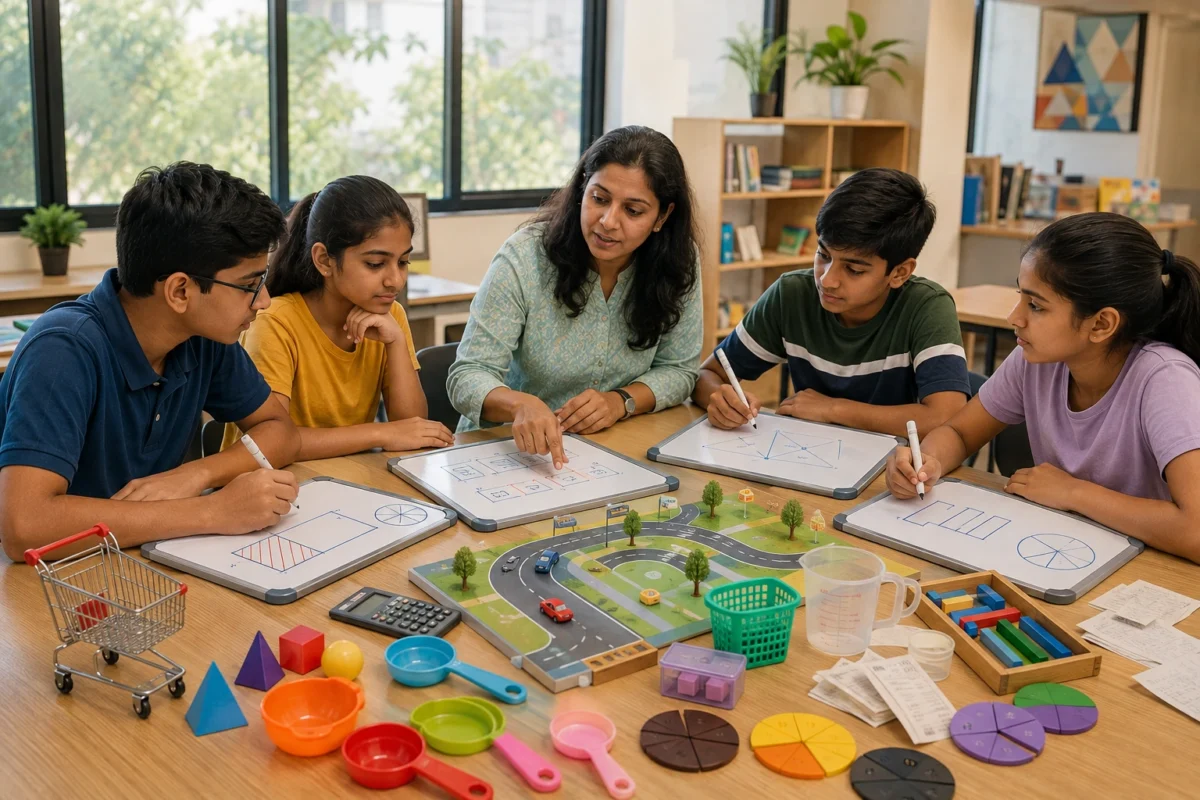
For many students, mathematics feels manageable until they encounter a word problem. They know how to solve equations, calculate percentages, or work with fractions, but when the same concepts appear inside a paragraph, they suddenly feel confused.
The issue usually isn’t mathematics itself—it’s understanding the situation described in the question and converting it into mathematical steps.
Word problems test much more than calculation skills. They evaluate logical thinking, reading comprehension, reasoning ability, and problem-solving confidence. Students in Classes 6–10 often lose valuable marks not because they don’t know the concept, but because they misunderstand what the question is asking.
At CH Math Tuition Point, we help students build the confidence to approach every word problem with a clear strategy instead of guessing.
Why Are Maths Word Problems Challenging?
Unlike direct mathematical questions, word problems require students to think through several stages before they even begin calculating.
Students must:
- Read carefully.
- Understand the situation.
- Identify important information.
- Ignore unnecessary details.
- Choose the correct mathematical operation.
- Solve accurately.
- Check whether the answer makes sense.
Missing just one of these steps can lead to an incorrect answer.
For example, a student might know how to calculate percentages perfectly but still struggle with a shopping discount problem simply because they misunderstand what “discount” actually represents.
Understanding the language of mathematics is just as important as understanding numbers.
Read Before You Calculate
One of the biggest mistakes students make is rushing to perform calculations as soon as they see numbers.
Instead, students should read the complete question carefully before picking up a calculator or writing equations.
Ask yourself:
- What is happening?
- What information is provided?
- What am I being asked to find?
Reading the question twice often prevents simple mistakes and helps students avoid solving the wrong problem.
Identify the Real Question
Many students begin calculating without first identifying what the question actually asks.
Consider this example:
“A train travels 240 kilometres in four hours. Find its average speed.”
The question isn’t asking for the distance or time.
It asks for speed.
Recognising the required answer immediately guides students toward the correct formula.
Before solving any word problem, complete this sentence:
“I need to find __.”
This simple habit improves accuracy significantly.
Highlight Important Information
Word problems sometimes include extra details that are not required for the solution.
Students should learn to separate useful information from background information.
Suppose a question says:
“Rahul goes shopping on Sunday carrying ₹2,000. He buys four notebooks costing ₹75 each. How much does he spend?”
The day of the week and the amount of money Rahul carried are not needed.
The useful information is:
Four notebooks
₹75 each
Identifying essential information keeps the calculation simple.
Convert Words Into Mathematics
Every word problem tells a mathematical story.
Students should focus on translating that story into numbers and equations.
For example:
- “Shared equally” usually suggests division.
- “Altogether” often indicates addition.
- “Difference” relates to subtraction.
- “Twice” means multiply by two.
- “Percentage of” requires percentage calculations.
However, students should avoid relying only on keywords. Understanding the overall situation is much more important than memorising vocabulary.
Draw Diagrams Whenever Possible
Many mathematics questions become much easier when students draw a simple diagram.
This is especially useful for:
- Geometry
- Measurement
- Distance
- Fractions
- Ratio
- Time problems
A rough sketch helps students organise information and see relationships more clearly.
The diagram doesn’t need to be perfect.
Its purpose is simply to make the problem easier to understand.
Break Large Problems Into Smaller Steps
Long questions often appear difficult because students try solving everything at once.
Instead, divide the problem into smaller calculations.
For example:
“Three books cost ₹180 each and two notebooks cost ₹60 each. Find the total amount spent.”
Rather than calculating everything mentally:
Books:
3 × 180 = 540
Notebooks:
2 × 60 = 120
Total:
540 + 120 = ₹660
Breaking questions into smaller parts reduces mistakes and improves confidence.
Estimate Your Answer
Before calculating exactly, students should estimate the expected answer.
If an item costs ₹500 and receives a 10% discount, the final price should be slightly below ₹500—not ₹800 or ₹1,200.
Estimation acts as a quick error detector.
If the calculated answer seems unreasonable, students know they should check their work before moving on.
Write Every Important Step
Showing working isn’t just helpful for teachers—it also helps students.
Writing important steps allows students to:
- Spot mistakes quickly.
- Check calculations easily.
- Follow logical reasoning.
- Reduce careless errors.
Organised working becomes increasingly valuable as questions become longer in higher classes.
Check the Final Answer
Many students stop as soon as they reach an answer.
Successful students always ask:
- Did I answer the correct question?
- Does my answer make sense?
- Have I written the correct unit?
- Is my calculation reasonable?
These final checks take less than a minute but can save several marks in an examination.
Use Everyday Situations to Practise
Parents can help children improve word-problem skills using daily activities.
Examples include:
- Shopping discounts
- Petrol calculations
- Cooking measurements
- Travel distances
- Time management
- Pocket money budgeting
When students see mathematics in everyday life, word problems become much more meaningful.
Practise Different Types of Word Problems
Instead of solving twenty nearly identical questions, students should experience variety.
Examples include:
- Shopping calculations
- Profit and loss
- Distance and speed
- Time problems
- Geometry applications
- Fractions
- Ratios
- Percentages
- Data interpretation
This prepares students for unfamiliar exam questions.
How CH Math Tuition Point Helps Students
At CH Math Tuition Point, we believe strong mathematical reasoning develops through guided practice and concept clarity.
Our teaching focuses on:
- Concept-based learning
- Step-by-step problem solving
- Real-life mathematical applications
- Logical thinking development
- Regular practice worksheets
- Weekly assessments
- Individual doubt clarification
- Exam-oriented preparation
- Confidence building
Students gradually learn to understand questions instead of memorising methods.
Conclusion
Maths word problems don’t become easier because students memorise more formulas.
They become easier because students learn how to think.
Following a structured approach—
Read → Understand → Identify → Plan → Solve → Check
helps students tackle even challenging problems with confidence.
With regular guided practice, logical reasoning develops naturally, and mathematics becomes less about guessing and more about understanding.
At CH Math Tuition Point, we help students in Classes 6–10 strengthen their problem-solving skills through structured learning, real-life examples, and continuous practice so they can perform confidently in school and competitive examinations.
Call to Action
Help Your Child Become a Confident Maths Problem Solver
Is your child finding maths word problems confusing? At CH Math Tuition Point, we help students in Classes 6–10 develop strong concepts, logical thinking, and exam confidence through personalized guidance, regular assessments, and practical problem-solving techniques.
Whether your child needs help with algebra, geometry, fractions, percentages, or exam preparation, our experienced faculty provides structured learning in a supportive environment.
📍Vivekananda Nagar, Kukatpally, Hyderabad
📞 Contact CH Math Tuition Point to enquire about classes.